Friday, 21 February 2014

CHAPTER 10: EXTENDING THE ORGANIZATION - SUPPLY CHAIN MANAGEMENT

CHAPTER 10: EXTENDING THE ORGANIZATION­- SUPPLY CHAIN MANAGEMENT


Assalamualaikum u olls..! Today I would like to post a new chapter in IT which is extending the organization which is Supply Chain Management (SCM)

            BASIC OF SUPPLY CHAIN BASIC
·         The supply chain has three main links:

1.      Materials flow from suppliers and their “upstream” suppliers at all levels
2.      Transformation of materials into semifinished and finished products through the organization’s own production process
3.      Distribution of products to customers and their “downstream” customers at all levels

·         Organizations must embrace technologies that can effectively manage supply chains


INFORMATION TECHNOLOGY’S ROLE IN THE SUPPLY CHAIN
·         IT’s primary role is to create integrations or tight process and information linkages between functions within a firm


 Diagram below show the Factors driving SCM


VISIBILITY
·         Supply chain visibility – the ability to view all areas up and down the supply chain
·         Bullwhip effect – occurs when distorted product demand information passes from one entity to the next throughout the supply chain


CONSUMER BEHAVIOUR
·         Companies can respond faster and more effectively to consumer demands through supply chain enhances
·         Demand planning software – generates demand forecasts using statistical tools and forecasting techniques


COMPETITION
·         Supply chain planning (SCP) software– uses advanced mathematical algorithms to improve the flow and efficiency of the supply chain
·         Supply chain execution (SCE) software – automates the different steps and stages of the supply chain

Here some picture shows the SCP and SCE in the supply chain.


                  SPEED
                        There are 3 factors that fostering speed


                 SUPPLY CHAIN MANAGEMENT SUCCESS FACTORS
                        According picture below it is show that there 7 principles of SCM


TQ for reading my blog... 


Friday, 14 February 2014

CHAPTER 9: ENABLING THE ORGANIZATION- DECISION MAKING

CHAPTER 9: ENABLING THE ORGANIZATION- DECISION MAKING


Assalamualaikum..hye hye..!! Today I would like to write about my new chapter in IT which is Enabling The Organization-Decision Making

·         Reasons for the growth of decision-making information systems
     People need to analyze large amounts of information
     People must make decisions quickly
     People must apply sophisticated analysis techniques, such as modeling and forecasting, to make good decisions
     People must protect the corporate asset of organizational information

·         Model – a simplified representation or abstraction of reality
·         IT systems in an enterprise


TRANSACTION PROCESSING SYSTEMS

·         Moving up through the organizational pyramid users move from requiring transactional information to analytical information


·         Transaction processing system - the basic business system that serves the operational level (analysts) in an organization
·         Online transaction processing (OLTP) – the capturing of transaction and event information using technology to (1) process the information according to defined business rules, (2) store the information, (3) update existing information to reflect the new information
·         Online analytical processing (OLAP) – the manipulation of information to create business intelligence in support of strategic decision making

DECISION SUPPORT SYSTEMS

·         Decision support system (DSS) – models information to support managers and business professionals during the decision-making process
·         Three quantitative models used by DSSs include:

1.      Sensitivity analysis
2.      What-if analysis
3.      Goal-seeking analysis

·         Interaction between a TPS and a DSS


EXECUTIVE INFORMATION SYSTEM

·         Executive information system (EIS) – a specialized DSS that supports senior level executives within the organization

·         Interaction between a TPS and an EIS


ARTIFICIAL INTELLIGENCE

·         Intelligent system – various commercial applications of artificial intelligence
·         Artificial intelligence (AI) – simulates human intelligence such as the ability to reason and learn
     Advantages: can check info on competitor

·         Four most common categories of AI include:

     Expert system
     Neural Network
     Genetic algorithm
     Intelligent agent

DATA MINING

·         Data-mining software includes many forms of AI such as neural networks and expert systems


·         Common forms of data-mining analysis capabilities include:
     Cluster analysis
     Association detection
     Statistical analysis

CLUSTER ANALYSIS

·         Cluster analysis – a technique used to divide an information set into mutually exclusive groups such that the members of each group are as close together as possible to one another and the different groups are as far apart as possible
·         CRM systems depend on cluster analysis to segment customer information and identify behavioral traits

ASSOCIATION DETECTION

·         Association detection – reveals the degree to which variables are related and the nature and frequency of these relationships in the information
     Market basket analysisanalyzes such items as Web sites and checkout scanner information to detect customers’ buying behavior and predict future behavior by identifying affinities among customers’ choices of products and services

STATISTICAL ANALYSIS

·         Statistical analysisperforms such functions as information correlations, distributions, calculations, and variance analysis
     Forecastpredictions made on the basis of time-series information
     Time-series informationtime-stamped information collected at a particular frequency

Thank you for reading my blog :)


Thursday, 30 January 2014

CHAPTER 8: ACCESSING ORGANIZATIONAL INFORMATION – DATA WAREHOUSE

CHAPTER 8: ACCESSING ORGANIZATIONAL INFORMATION – DATA    
                       WAREHOUSE


Assalamualaikum...olla everyone..!tonight I would like to give new infomation for chapter 8.. :) 


DATA WAREHOUSE FUNDAMENTALS

·         Data warehouse – a logical collection of information – gathered from many different operational databases – that supports business analysis activities and decision-making tasks
·         The primary purpose of a data warehouse is to aggregate information throughout an organization into a single repository for decision-making purposes
·         Extraction, transformation, and loading (ETL) – a process that extracts information from internal and external databases, transforms the information using a common set of enterprise definitions, and loads the information into a data warehouse
·         Data mart – contains a subset of data warehouse information

Here a model that help to understand for data warehouse fundamentals


MULTIDIMENSIONAL ANALYSIS AND DATA MINING

·         Databases contain information in a series of two-dimensional tables
·         In a data warehouse and data mart, information is multidimensional, it contains layers of columns and rows
     Dimension – a particular attribute of information
·         Cube – common term for the representation of multidimensional information


·         Data mining – the process of analyzing data to extract information not offered by the raw data alone
·         To perform data mining users need data-mining tools
     Data-mining tool – uses a variety of techniques to find patterns and relationships in large volumes of information and infers rules that predict future behavior and guide decision making


INFORMATION CLEANSING OR SCRUBBING

·         An organization must maintain high-quality data in the data warehouse
·         Information cleansing or scrubbing – a process that weeds out and fixes or discards inconsistent, incorrect, or incomplete information
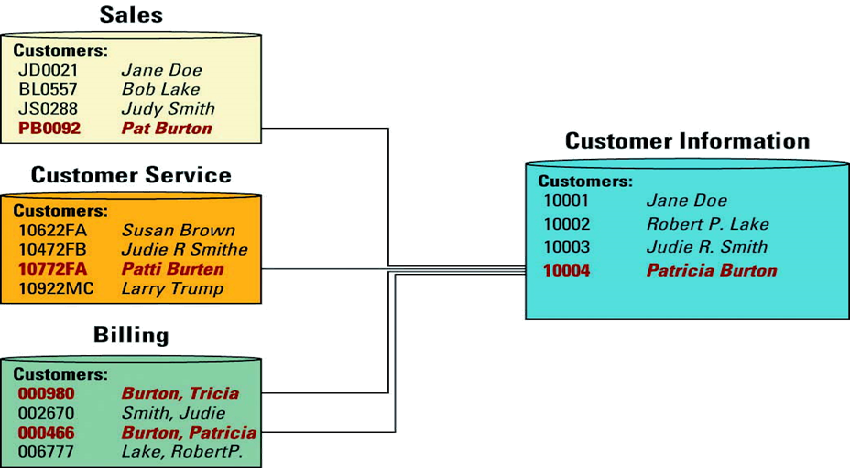
For example:

Contact information in an operational system


Then, standardizing customer name from Operational Systems


 After that, it goes to information cleansing activities.


Lastly, the organization will get accurate and complete information


BUSINESS INTELLIGENCE

·         Business intelligence – information that people use to support their decision-making efforts
·         Principle BI enablers include:
     Technology
     People
     Culture

THE END... :) thanks for reading my entry :)


CHAPTER 7: STORING ORGANIZATIONAL INFORMTAION-DATABASE

CHAPTER 7: STORING ORGANIZATIONAL INFORMATION-DATABASE


Assalamualaikum..hye u olls..today I would like to give short info about seventh chapter in IT.Lets check it out..! :)

          RELATIONAL DATABASE FUNDAMENTALS
·         Information is stored in databases
     Database – maintains information about various types of objects (inventory), events (transactions), people (employees), and places (warehouses)

·         Database models include:
     Hierarchical database model – information is organized into a tree-like structure (using parent/child relationships) in such a way that it cannot have too many relationships
     Network database model – a flexible way of representing objects and their relationships
     Relational database model – stores information in the form of logically related two-dimensional tables
This picture below show the hierarchical, network and relational structure:


·         Entity – a person, place, thing, transaction, or event about which information is stored
     The rows in each table contain the entities
     Attributes (fields, columns) – characteristics or properties of an entity class
     The columns in each table contain the attribute

KEY AND RELATIONSHIP

     Primary key – a field (or group of fields) that uniquely identifies a given entity in a table
     Foreign key – a primary key of one table that appears an attribute in another table and acts to provide a logical relationship among the two tables

For example, let us look at potential relational database for Coca-Cola


                RELATIONAL DATABASE ADVANTAGES

·         Database advantages from a business perspective include
     Increased flexibility
     Increased scalability and performance
     Reduced information redundancy
     Increased information integrity (quality)
     Increased information security

     INCREASE FLEXIBILITY 
                                 
·         A well-designed database should:
     Handle changes quickly and easily
     Provide users with different views
     Have only one physical view
     Have multiple logical views

   INCREASED SCALABILITY AND PERFORMANCE

·         A database must scale to meet increased demand,  while maintaining acceptable performance levels
     Scalability – refers to how well a system can adapt to increased demands
     Performance – measures how quickly a system performs a certain process or transaction

REDUCED INFORMATION REDUNDANCY

·         Databases reduce information redundancy
     Redundancy – the duplication of information or storing the same information in multiple places
     Inconsistency is one of the primary problems with redundant information-difficult to decide which is most current and most accurate

INCREASE INFORMATION INTEGRITY (QUALITY)
·         Information integrity – measures the quality of information
·         Integrity constraint – rules that help ensure the quality of information

INCREASE INFORMATION SECURITY
·         Information is an organizational asset and must be protected
·         Databases offer several security features including:
     Password – provides authentication of the user
     Access level – determines who has access to the different types of information
     Access control – determines types of user access, such as read-only access


DATABASE MANAGEMENT SYSTEM
·         Database management systems (DBMS) – software through which users and application programs interact with a database


      DATA-DRIVEN WEBSITE


·         Data-driven Web sites an interactive Web site kept constantly updated and relevant to the needs of its customers through the use of a database


    DATA-DRIVEN WEB SITE BUSINESS ADVANTAGES
·         Development
·         Content management
·         Future expandability
·         Minimizing human error
·         Cutting production and update costs


                   DATA-DRIVEN BUSINESS INTELLIGENCE
·         BI in a data-driven Web site


INTEGRATING INFORMATION AMONG MULTIPLE DATABASES
·         Integration – allows separate systems to communicate directly with each other

     Forward integration – takes information entered into a given system and sends it automatically to all downstream systems and processes
     Backward integration – takes information entered into a given system and sends it automatically to all upstream systems and processes

·         Do you know that what would happen when there is no integration, an organization will:

     Spend considerable time entering the same info in multiple system
     Suffer from the low quality and inconsistency typically embedded in redundant info


END FOR CHAPTER 7. THANK YOU FOR READ
:)