Thursday, 30 January 2014

CHAPTER 8: ACCESSING ORGANIZATIONAL INFORMATION – DATA WAREHOUSE

CHAPTER 8: ACCESSING ORGANIZATIONAL INFORMATION – DATA    
                       WAREHOUSE


Assalamualaikum...olla everyone..!tonight I would like to give new infomation for chapter 8.. :) 


DATA WAREHOUSE FUNDAMENTALS

·         Data warehouse – a logical collection of information – gathered from many different operational databases – that supports business analysis activities and decision-making tasks
·         The primary purpose of a data warehouse is to aggregate information throughout an organization into a single repository for decision-making purposes
·         Extraction, transformation, and loading (ETL) – a process that extracts information from internal and external databases, transforms the information using a common set of enterprise definitions, and loads the information into a data warehouse
·         Data mart – contains a subset of data warehouse information

Here a model that help to understand for data warehouse fundamentals


MULTIDIMENSIONAL ANALYSIS AND DATA MINING

·         Databases contain information in a series of two-dimensional tables
·         In a data warehouse and data mart, information is multidimensional, it contains layers of columns and rows
–     Dimension – a particular attribute of information
·         Cube – common term for the representation of multidimensional information


·         Data mining – the process of analyzing data to extract information not offered by the raw data alone
·         To perform data mining users need data-mining tools
–     Data-mining tool – uses a variety of techniques to find patterns and relationships in large volumes of information and infers rules that predict future behavior and guide decision making


INFORMATION CLEANSING OR SCRUBBING

·         An organization must maintain high-quality data in the data warehouse
·         Information cleansing or scrubbing – a process that weeds out and fixes or discards inconsistent, incorrect, or incomplete information
For example:

Contact information in an operational system


Then, standardizing customer name from Operational Systems
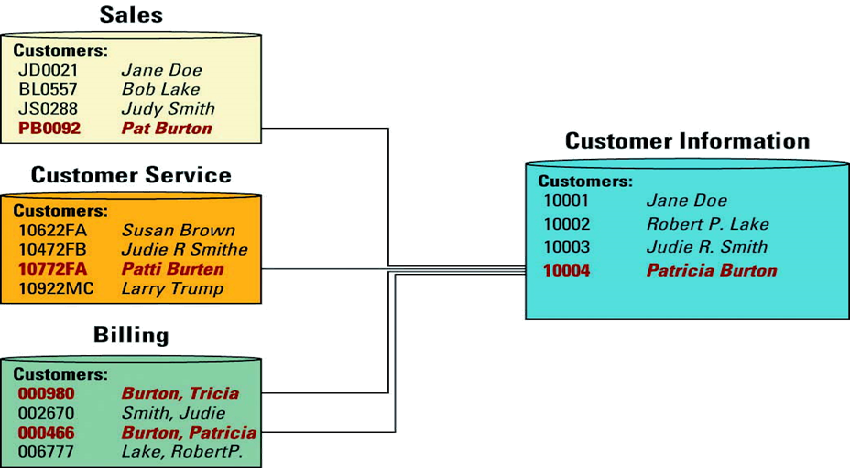


 After that, it goes to information cleansing activities.


Lastly, the organization will get accurate and complete information


BUSINESS INTELLIGENCE

·         Business intelligence – information that people use to support their decision-making efforts
·         Principle BI enablers include:
–     Technology
–     People
–     Culture

THE END... :) thanks for reading my entry :)


CHAPTER 7: STORING ORGANIZATIONAL INFORMTAION-DATABASE

CHAPTER 7: STORING ORGANIZATIONAL INFORMATION-DATABASE


Assalamualaikum..hye u olls..today I would like to give short info about seventh chapter in IT.Lets check it out..! :)

          RELATIONAL DATABASE FUNDAMENTALS
·         Information is stored in databases
–     Database – maintains information about various types of objects (inventory), events (transactions), people (employees), and places (warehouses)

·         Database models include:
–     Hierarchical database model – information is organized into a tree-like structure (using parent/child relationships) in such a way that it cannot have too many relationships
–     Network database model – a flexible way of representing objects and their relationships
–     Relational database model – stores information in the form of logically related two-dimensional tables
This picture below show the hierarchical, network and relational structure:


·         Entity – a person, place, thing, transaction, or event about which information is stored
–     The rows in each table contain the entities
–     Attributes (fields, columns) – characteristics or properties of an entity class
–     The columns in each table contain the attribute

KEY AND RELATIONSHIP

–     Primary key – a field (or group of fields) that uniquely identifies a given entity in a table
–     Foreign key – a primary key of one table that appears an attribute in another table and acts to provide a logical relationship among the two tables

For example, let us look at potential relational database for Coca-Cola


                RELATIONAL DATABASE ADVANTAGES

·         Database advantages from a business perspective include
–     Increased flexibility
–     Increased scalability and performance
–     Reduced information redundancy
–     Increased information integrity (quality)
–     Increased information security

     INCREASE FLEXIBILITY 
                                 
·         A well-designed database should:
–     Handle changes quickly and easily
–     Provide users with different views
–     Have only one physical view
–     Have multiple logical views

   INCREASED SCALABILITY AND PERFORMANCE

·         A database must scale to meet increased demand,  while maintaining acceptable performance levels
–     Scalability – refers to how well a system can adapt to increased demands
–     Performance – measures how quickly a system performs a certain process or transaction

REDUCED INFORMATION REDUNDANCY

·         Databases reduce information redundancy
–     Redundancy – the duplication of information or storing the same information in multiple places
–     Inconsistency is one of the primary problems with redundant information-difficult to decide which is most current and most accurate

INCREASE INFORMATION INTEGRITY (QUALITY)
·         Information integrity – measures the quality of information
·         Integrity constraint – rules that help ensure the quality of information

INCREASE INFORMATION SECURITY
·         Information is an organizational asset and must be protected
·         Databases offer several security features including:
–     Password – provides authentication of the user
–     Access level – determines who has access to the different types of information
–     Access control – determines types of user access, such as read-only access


DATABASE MANAGEMENT SYSTEM
·         Database management systems (DBMS) – software through which users and application programs interact with a database


      DATA-DRIVEN WEBSITE


·         Data-driven Web sites – an interactive Web site kept constantly updated and relevant to the needs of its customers through the use of a database


    DATA-DRIVEN WEB SITE BUSINESS ADVANTAGES
·         Development
·         Content management
·         Future expandability
·         Minimizing human error
·         Cutting production and update costs


                   DATA-DRIVEN BUSINESS INTELLIGENCE
·         BI in a data-driven Web site


INTEGRATING INFORMATION AMONG MULTIPLE DATABASES
·         Integration – allows separate systems to communicate directly with each other

–     Forward integration – takes information entered into a given system and sends it automatically to all downstream systems and processes
–     Backward integration – takes information entered into a given system and sends it automatically to all upstream systems and processes

·         Do you know that what would happen when there is no integration, an organization will:

–     Spend considerable time entering the same info in multiple system
–     Suffer from the low quality and inconsistency typically embedded in redundant info


END FOR CHAPTER 7. THANK YOU FOR READ
:)


Thursday, 16 January 2014

PROJECT FOCUS :)

Norzulaiha Bt. Alias
Noor Asniza Bt. Asmaddin
Ayuliza Bt. Kasim
Nurul Aisyah Bt. Ahmanul
Nur Atila Bt. Abdul Rahman
Putri Azizuhainee Bt. Mohd. Khalid

Question :
We know that people use information technology to work with information. Knowing this, how could these types of errors occur? What could happen if you decided to use Facebook to collect information intelligence for a research paper? What could Facebook do to help prevent these types of errors?


Here are some references to determine whether the information obtain is a good or bad;


Problems that may occur:

Facebook is a website that is generally open to all.  The information can be easily falsify and does not need to be filtered. Thus, why the information is not credible for the use of a research. The information obtain may not be true or valid and may not be based on facts. Furthermore, the information at facebook may be biased as it is based on ones opinion and perception. Lastly, we have no way to insure that the information that is posted on facebook is valid as for we do not know the sources of information and its credibility.

Prevention that Facebook may do to prevent these problems:
Facebook should filter the information posted on their website or increase its security by valuating its information and sources.


Friday, 10 January 2014

CHAPTER 6: VALUING ORGANIZATIONAL INFORMATION

CHAPTER 6: VALUING ORGANIZATIONAL INFORMATION


Assalamualaikum..hello everybody..! 

            0rganizational Information
 Information is everywhere in an organization
•         Employees must be able to obtain and analyze the many different levels, formats, and granularities of organizational information to make decisions
•         Successfully collecting, compiling, sorting, and analyzing information can provide tremendous insight into how an organization is performing

Table below shows the Levels, Formats, and Granularities of Organizational Information.


While, the below diagram shows the transactional versus analytical information.


The Value of Timely Information

•         Timeliness is an aspect of information that depends on the situation
–     Real-time information – immediate, up-to-date information
–     Real-time system – provides real-time information in response to query requests

The Value of Quality Information

•         Business decisions are only as good as the quality of the information used to make the decisions
•         You never want to find yourself using technology to help you make a bad decision faster
            
             Here some of characteristics of high-quality information include:


             Picture below shows the Low-Quality Information Example


            Understanding The Cost Of Poor Information

            The four primary sources of low quality information include:
1.      Online customers intentionally enter inaccurate information to protect their privacy
2.      Information from different systems have different entry standards and formats
3.      Call center operators enter abbreviated or erroneous information by accident or to save time
4.      Third party and external information contains inconsistencies, inaccuracies, and errors

Potential business effects resulting from low quality information include:
–     Inability to accurately track customers
–     Difficulty identifying valuable customers
–     Inability to identify selling opportunities
–     Marketing to nonexistent customers
–     Difficulty tracking revenue due to inaccurate invoices
–     Inability to build strong customer relationships


Understanding The Benefits of Good Information
•          High quality information can significantly improve the chances of making a good decision
•         Good decisions can directly impact an organization's bottom line

             Thats all from me..thank you for visiting.. :)


THE END....